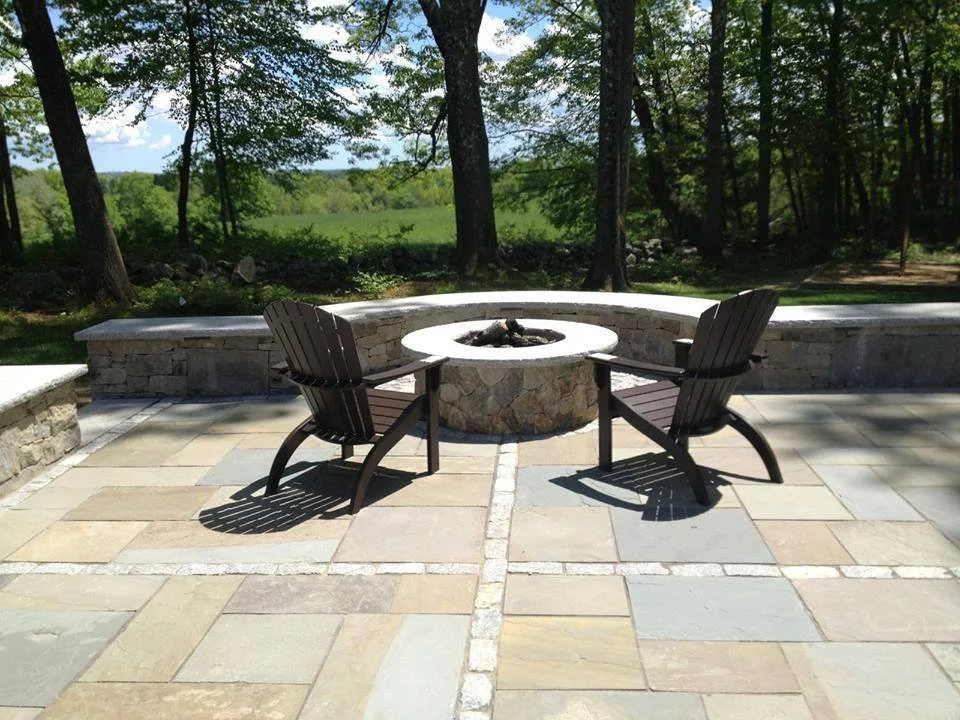
Hiring a fire pit contractor in Milford, NH, is less about picking a shape out of a catalog and more about reading your yard. Prevailing wind, sightlines, grade and the way your family actually sits outside all shape the finished feature.
Our team at Northern Lights designs and builds custom fire pits across southern New Hampshire, and we bring over 34 years of combined experience in designing and building custom outdoor spaces to every one of them. This guide covers the decisions we make with homeowners before a single stone gets set.
A fire pit is a different structure than a built-in fireplace. It sits open on every side, people gather around the full circumference, and no chimney carries smoke away from the seating. That geometry drives what follows: where the feature belongs, how much hardscape surrounds it, how tall the wall sits and which fuel suits your household.
Get those four right and the pit becomes the spot everyone drifts toward on a cool September evening.
Related: Elevate Your Outdoor Space With an Intricately Detailed Fire Pit in Weston and Wellesley, MA
How Far Should a Fire Pit Sit From the House and the Tree Line?
Plan on a minimum of 10 to 15 feet of clear distance between the outside edge of the fire pit and any structure, and more where the wind funnels. The house wall, a wood deck, a fence, a shed and the fuel tank all get measured, not eyeballed. Towns in Hillsborough County apply their own separation and burn rules, so we confirm the local requirement before setting the layout.
Overhead clearance matters as much as the horizontal number. A white pine limb hanging 12 feet above an open wood fire is a genuine hazard, and the resin heavy needles pile up in the bowl. We map the canopy during the site visit and either shift the pit into open sky or prune the crown back first.
Grade is the third factor. Smoke and heat drift uphill, so a pit tucked at the low corner of a sloped yard pushes smoke at a screened porch above it. On sloping lots we pair the pit with a terrace held by a low seating wall, which levels the gathering area and puts the fire on the same plane as the people around it.
Is a Gas or Wood Burning Fire Pit the Right Call for a New Hampshire Backyard?
Gas suits households that want fire on a weeknight with no cleanup. Wood suits households that treat the fire itself as the activity. In a pit the choice carries different weight than it does in a fireplace, because no firebox and no flue shape the burn. Your answer changes the interior build, the plumbing and the daily routine.
What a Gas Pit Changes About the Build
A gas pit needs a sealed burner pan, a listed burner ring sized to the opening, an ignition you reach without leaning over the flame, and code compliant venting through the pit wall. Propane is heavier than air and settles, so the vents sit low and stay open. On natural gas the supply line gets trenched and pressure tested before the patio surface goes down, which is why fuel is settled early in our design process.
The payoff is control. A gas pit lights in seconds, holds steady flame at the height you set, throws no sparks and shuts off when you walk inside. For families with young children, properties under heavy tree cover, or anyone facing a seasonal burn restriction, that reliability usually decides it.
What a Wood Burning Pit Asks of You
A wood pit wants a steel combustion ring or a firebrick liner, an air gap behind it, and drainage out of the bowl so meltwater does not sit on the ash bed. It also wants somewhere dry to season cordwood, worth planning into the landscape rather than solving with a tarp later. In exchange you get real radiant heat, the sound and the smell.
How Big Should a Fire Pit Be and How Much Room Belongs Around It?
A 36 to 44 inch outside diameter with an 18 to 24 inch fire bowl seats six to eight people comfortably. Go wider and the people opposite sit far enough away that conversation splits in two. Go narrower and the heat gets uncomfortable at close range.
Around that pit, allow at least 7 feet of usable hardscape measured out from the outside face, on every side. Chairs take roughly 3 feet of depth once someone leans back, and a walking lane behind them takes another 3 to 4 feet. On a 40 inch pit that works out to a paved circle roughly 18 feet across.
Seat Height, Seat Depth and the Height of the Wall
Built in seating solves the crowding problem, and the numbers are tight. A seat wall finishes at 18 inches to the top of the cap and runs 16 to 18 inches deep so an adult sits back without perching. The pit wall finishes lower, generally 14 to 18 inches, so seated guests look over the rim at flame instead of at stone.
We usually run the seat wall around 60 percent of the circle rather than the full ring. That leaves two clear entry points and room for movable chairs when the group grows. The cap stone is where seating either feels generous or feels like an afterthought, so we specify full depth caps with eased edges.
What Goes Under a Fire Pit So It Survives New Hampshire Freeze Thaw?
Everything that fails on a fire pit in this climate fails from below. Water gets into the base, freezes, expands and lifts the assembly, and by the third spring the caps sit uneven and the joints have opened. Frost depth in southern New Hampshire runs to roughly 48 inches, deeper than most homeowners expect.
For a dry laid pit set into a patio, we excavate through topsoil into stable subgrade, compact in lifts of three quarter inch crushed stone, and keep the assembly draining. The pit and the paving then move as one floating system, so seasonal heave lifts and settles everything at the same rate.
Mortared pits follow a different rule. Mortar has no tolerance for differential movement, so that build gets a reinforced footing carried below frost, or an engineered slab on compacted stone with the water controlled underneath. We make that call on site, because Milford ground shifts between sandy glacial till and heavy clay inside one neighborhood.
Drainage Details That Get Skipped
An open pit collects rain and snowmelt by definition. A wood burning bowl gets a drain through the base into a stone sump so water leaves instead of pooling on ash. A gas pit gets weep holes in the burner pan, set above the surrounding grade. Skip either detail and you get corroded hardware and a burner that will not light in April.
The paving around the fire feature carries the same rule. We pitch the surrounding patio surface away at about a quarter inch per foot, which is enough to shed water and gentle enough that a chair still sits level.
Which Materials Hold Up Around an Open Fire in New England?
The interior and exterior of a pit are two separate material problems. Inside, you need something rated for direct flame: firebrick in refractory mortar, or a heavy gauge steel combustion ring. Outside, you need stone that shrugs off UV, road salt tracked in on boots and dozens of freeze thaw cycles a winter.
Stone, Block and What Fails Under Heat
New England fieldstone and granite handle heat and weather well, which is why they appear on so many of the pits we build in Hillsborough County. Bluestone makes a fine cap and an excellent patio surface, though it stays off the inner face where flame touches directly. Manufactured wall block such as Unilock gives a consistent radius, and the better units are rated for fire feature use.
The material to watch is any dense, moisture holding stone set against direct flame. Trapped water turns to steam and the face spalls off in flakes. River rounds and cobbles belong in the landscape around the pit, not inside the bowl, and the same caution applies to unrated concrete pavers.
Cap Details and Edges
The cap is the detail people touch, and the detail that fails first. We pitch caps slightly outward so water runs off instead of sitting in a joint, use full pieces instead of narrow slivers around the curve, and ease the top edge. On mortared work the joints get raked, tooled and sealed, because an open horizontal joint is an invitation for ice.

How Long Does a Custom Fire Pit Project Take in Milford, NH?
A dry laid fire pit set into an existing patio typically runs two to four days on site. A pit built with a new patio, seat walls, lighting and a gas line generally runs one to three weeks. Design and material selection sit ahead of that, so most homeowners start six to ten weeks before they want to sit by the fire.
Season matters here. Mortar and polymeric sand want temperatures above 40 degrees, so mortared work generally runs April through November. Dry laid construction stretches later into the fall, and a late autumn build is ready for the first cold snap instead of waiting out a spring backlog.
During construction our project managers update clients every two to three days, so you know what happened on site and what comes next. That cadence matters most where the pit is one piece of a larger backyard plan.
Can You Use a Backyard Fire Pit Through a New Hampshire Winter?
A well built fire pit often gets more use between October and April than it does in July. A gas pit lights in the cold as long as the burner drains and the ignition stays dry under a fitted cover. A wood pit works all winter provided you clear snow out of the bowl first, since melting snow against hot masonry is hard on the assembly.
Two things extend the season further. Low voltage lighting along the surrounding paving keeps the space usable once the sun sets at half past four, and a shade structure or roofed seating area nearby gives guests somewhere to step out of the wind without going indoors.
Homeowners who cook outdoors often pair the pit with a compact outdoor kitchen so the group stays in one place through the shoulder seasons.
Reading Wind and Smoke Before the Spot Is Chosen
Siting is the decision homeowners most often make on instinct and most often regret. The instinct is to center the pit in the yard. The better approach is to watch where the wind goes.
In this part of New Hampshire the summer breeze comes out of the southwest, so a pit placed southwest of a screened porch sends smoke into it on warm evenings.
We look for open sky above, a windbreak on the upwind side, and a view worth sitting toward. A tree line, a run of dense evergreen planting or an existing retaining wall serves as that break. What you do not want is a pit boxed in on all four sides, because still air lets smoke hang at seated head height.
Why Homeowners Bring In a Local Team for Fire Pit Work
The parts of this job that decide how long a pit lasts are the parts nobody sees. Subgrade preparation, compaction in proper lifts, drainage under the bowl, a liner rated for your fuel, and cap work detailed so water leaves the surface. A crew that installs here year after year builds those details in as a matter of course.
Local knowledge covers the unglamorous items: where the frost line sits on your lot, how Milford handles outdoor burning, and how spring runoff moves across your grade. Our team has worked across Milford, Amherst, Bedford, Hollis and Peterborough long enough to know how those variables differ by town.
The last argument for a professional build is integration. A pit added as an afterthought looks added on. A pit designed with the patio, the walls and the lighting reads as one space, and that is what clients notice five years later.
Build Your Fire Pit With Northern Lights
If you are ready to talk through a fire pit for your property, our team will walk the yard with you, read the wind and the grade, and put a design and a budget in front of you before anything is committed.
We build custom fire pits, seating walls, patios and outdoor living spaces across Milford, NH, and Hillsborough County. Request a quote from Northern Lights and let us build the spot your family gathers around.
In Summary: Fire Pit Questions Milford Homeowners Ask Most
How far does a fire pit need to be from the house?
Plan on 10 to 15 feet of clear distance to any structure, deck or fuel tank, plus clear sky overhead, and confirm local burn rules before the layout is fixed.
Gas or wood for a backyard pit?
Gas gives you instant, spark free fire with no cleanup. Wood gives stronger radiant heat and the experience of tending a fire. The build details differ, so fuel gets chosen before excavation.
How much patio does a fire pit need around it?
Allow roughly 7 feet of paving out from the outside face on every side, which puts a 40 inch pit at the center of a circle about 18 feet across, with seat walls 18 inches high.
What makes a fire pit fail in New Hampshire?
Water under the base and no drainage out of the bowl. A compacted stone base, a drain or weep holes, and caps pitched to shed water carry a pit through repeated freeze thaw cycles.
Related: Start Enjoying Your Backyard Every Night By Adding a Fire Pit in Bedford, NH